
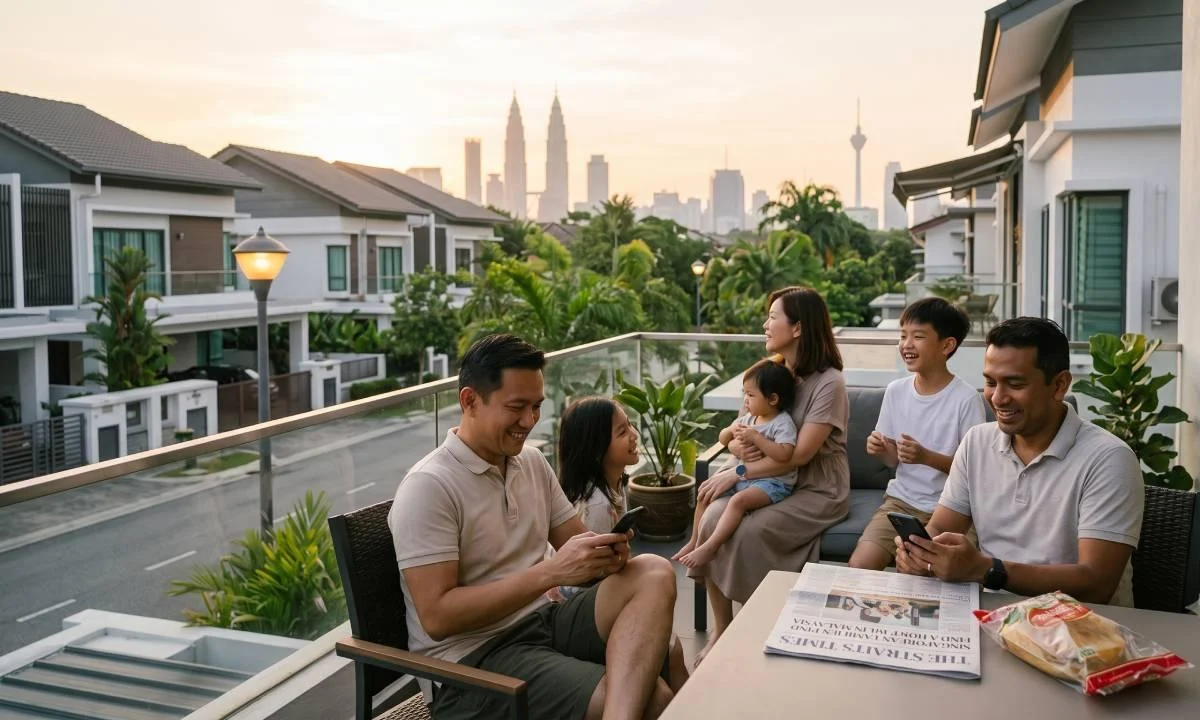

Introduction: A Shift in Priorities Beyond the Causeway
MM2H for Singaporeans has evolved well beyond a retirement programme. The Malaysia My Second Home (MM2H) programme is now attracting Singaporean families, mid-career professionals, and business owners who want more than a lower cost of living. They want more space, better quality of life, access to international education, and a long-term base for multi-generational living. For many, MM2H is the legal and financial pathway that makes it possible.
This article explains what Malaysia genuinely offers Singaporean families across seven key dimensions: space, multi-generational living, cultural familiarity, healthcare, education, legacy planning, and the MM2H framework itself. It also covers the four KL neighbourhoods most relevant to Singaporean buyers, with transaction data sourced from the NAPIC Property Market Report 2025.
TL;DR
• Singaporeans are choosing Malaysia not just for lower costs, but for space, family living, international education, and retirement confidence.
• The revised MM2H 2026 framework requires a compulsory property purchase alongside a fixed deposit — binding your visa to a real asset.
• The Silver Tier (from USD 150,000 fixed deposit + RM 600,000 property) suits most Singaporean buyers; in Kuala Lumpur, the state minimum raises the property threshold to RM 1,000,000.
• 50% of the fixed deposit can be withdrawn for approved expenses including the property purchase, significantly improving capital efficiency.
• Prime KL neighbourhoods (Mont Kiara, Bangsar, Desa ParkCity) offer larger homes, stronger rental yields, and quality-of-life advantages that Singapore’s land constraints simply cannot match.
• Hartamas International manages the full MM2H lifecycle, from application to property acquisition.
Table of Contents
1. How Much More Space Can Singaporeans Actually Get in Malaysia?
Space is the most immediate and tangible difference Singaporeans notice when they move to Malaysia.
The numbers tell a stark story:
- Property in Singapore’s city centre averages RM 9,197 per sq ft.
- The same metric for Kuala Lumpur is RM 1,556 per sq ft.
- That is a price difference of approximately 491% in the city centre — and over 1,000% outside the central core.
- Average new private home sizes in Singapore have shrunk from 1,270 sq ft (1995) to just 893 sq ft (2025).
What does this mean in practice?
- The capital required to buy a studio apartment in Singapore’s outer districts can purchase a premium 3-bedroom condominium of 1,500 sq ft or more in an established KL expatriate enclave such as Mont Kiara or Bangsar.
- Luxury condominiums in Desa ParkCity regularly feature floor plans exceeding 2,000 sq ft, with resort-style facilities.
- Landed homes in Bangsar offer 3,000 sq ft of space with private gardens, at prices that are financially unimaginable for equivalent land in Singapore.
For families who have spent years compromising — no study, no guest room, a folding dining table — Malaysia is a genuine lifestyle upgrade.
Pro Tip
A Singaporean buyer with SGD 500,000 to deploy can acquire a fully furnished, freehold 3-bedroom unit in Mont Kiara or Desa ParkCity, complete with resort-style facilities, while maintaining their Singaporean residence. This is not a downgrade. It is optionality.
2. What Is Making Multi-Generational Living Possible in Malaysia?
Multi-generational living is a priority for many Singaporean families. In Singapore, it is a logistical challenge. In Malaysia, it is practical.
The MM2H framework explicitly supports it. The principal applicant can include:
- Their spouse
- Unmarried children up to the age of 34
- Parents and parents-in-law above the age of 60 — on the same visa
This means an entire three-generation family can establish legitimate, long-term residency in Malaysia on a single application.
The physical space supports it too. In Kuala Lumpur, a 4- or 5-bedroom landed property or a sprawling condominium of 3,000 sq ft is within reach for many Singaporean buyers. The equivalent footprint in Singapore is financially prohibitive for most.
And the economics of full-time care are very different. The minimum wage for a domestic helper in Malaysia generally starts at RM 1,500 per month, compared to S$1,000 per month plus compulsory levies and agency fees of up to S$2,750 in Singapore. Families can afford personalised, live-in care for elderly parents without financial strain.
3. Is Malaysia Culturally Familiar Enough for Singaporeans?
Yes, and this is one of the most underappreciated factors in the decision.
Malaysia and Singapore share a great deal:
- Languages: Mandarin, Malay, Tamil, and English are all widely spoken across KL.
- Food culture: familiar hawker staples, Chinese coffee shops, and Indian restaurants — often more diverse in KL than at home.
- Social fabric: broadly similar values around family, community, and education.
Connectivity makes the dual-city life increasingly realistic:
- Regular flights connect KL and Singapore in under an hour.
- The Johor–Singapore Rapid Transit System (RTS Link), targeted to commence passenger service by December 2026, will further increase cross-border fluidity when it opens.
- For professionals maintaining business ties in Singapore, a dual-city lifestyle is operationally achievable today.
What Malaysia adds is a different quality of life: less density, more greenery, a slower rhythm. Established townships like Desa ParkCity, built around a 13.9-acre Central Park, and leafy enclaves like Bangsar offer an urban experience that feels markedly different from the compressed intensity of Singapore’s residential landscape.
Singaporeans do not have to leave familiarity behind. They simply gain something they cannot currently have at home.
4. How Does Malaysian Healthcare Compare for Retirement Planning?
Malaysia’s private healthcare system is consistently well-regarded internationally.
- It has ranked first in the World’s Best Healthcare category of the International Living Annual Global Retirement Index.
- Medical professionals throughout KL operate primarily in English.
- Modern, internationally accredited private hospitals are located within established residential enclaves, including ParkCity Medical Centre in Desa ParkCity.
The cost comparison against Singapore is significant:
- A major cardiac procedure at a Singapore private hospital costs approximately SGD 20,000.
- The equivalent procedure at a comparable Malaysian private facility costs between RM 8,000 and RM 16,000.
- That is a saving of 50% to 75%, before accounting for the favourable SGD-to-MYR exchange rate.
For retirees planning against longevity risk, this matters enormously. A retirement corpus that sustains 12 to 15 years in inflationary Singapore could reasonably span 25 to 30 years in Kuala Lumpur, without a reduction in the standard of care or the quality of daily life.
5. What Do International Schools in Malaysia Offer Singaporean Families?
Kuala Lumpur has developed a strong ecosystem of internationally recognised schools over the past two decades.
Families relocating with school-going children have access to:
- British, IB, Australian, and American curricula
- Modern campuses with extensive co-curricular programmes
- Schools specifically embedded within the most popular expatriate residential enclaves
Schools near KL’s prime residential areas include:
- Mont Kiara: Mont’Kiara International School (M’KIS), Garden International School
- Desa ParkCity: The International School @ ParkCity (ISPC)
- Sri Hartamas / Bangsar: British International School of Kuala Lumpur (BSKL), Cempaka International School
The cost comparison is compelling:
- International school fees in Singapore frequently exceed S$50,000 per child per year at top-tier institutions.
- In Malaysia, the comparable annual fee range is approximately RM 25,000 to RM 85,000, typically 30% to 40% lower.
- And the home the family lives in is significantly larger, at a fraction of the cost.
For families who value international education but find Singapore’s combination of school fees and housing costs increasingly prohibitive, Malaysia offers a compelling recalibration.
6. Can a Malaysian Property Become a Genuine Family Legacy?
This is where the conversation shifts from lifestyle to long-term planning.
A Malaysian property can serve different purposes across life stages:
- Early years: a family gathering place for school holidays and long weekends.
- Middle years: a genuine primary residence — a retirement base where savings are not eroded at the same rate.
- Later years: the multi-generational anchor that Singapore simply cannot accommodate at scale.
The financial case for long-term holding is strong:
- Under Malaysia’s Real Property Gains Tax (RPGT) framework, properties sold after five years of ownership are subject to a reduced RPGT rate of 10% for MM2H holders (who are classified as foreign buyers). [Note: the full RPGT exemption (0%) applies only to Malaysian citizens and permanent residents. Foreigners, including MM2H holders, pay 10% RPGT on any gains from year six onwards — there is no zero-rate tier for non-citizens.]
- There is no equivalent of Singapore’s ABSD — foreign buyers pay a flat 8% stamp duty at entry (effective 1 January 2026, raised from the previous 4% flat rate under Budget 2026).
- Gross rental yields in prime KL residential enclaves (Mont Kiara and Desa ParkCity in particular) typically range from 4% to 6%, outperforming most Singapore residential assets.
A Malaysian property, planned properly, can be both a home and a legacy.
7. How Does MM2H 2026 Work — And What Does It Cost?
The revised MM2H framework, fully operational in 2026, is a structured tiered residency programme administered by Malaysia’s Ministry of Tourism and the Immigration Department. The critical change from earlier iterations: a verified Sales and Purchase Agreement (SPA) is now a non-negotiable part of the application.
There are three mainland tiers, plus one geographically restricted zone tier:
|
Tier |
Pass Duration |
Min. Age |
Fixed Deposit (USD) |
Min. Property (RM) |
Participation Fee (RM) |
|---|---|---|---|---|---|
|
Silver |
5 years (renewable) |
25 |
USD 150,000 |
RM 600,000 * |
RM 1,000 |
|
Gold |
15 years (renewable) |
25 |
USD 500,000 |
RM 1,000,000 * |
RM 3,000 |
|
Platinum |
20 years (renewable) |
25 |
USD 1,000,000 |
RM 2,000,000 * |
RM 200,000 |
|
SEZ / SFZ (Forest City only) |
10 years (renewable) |
21 |
USD 32,000 (age 50+)USD 65,000 (age <50) |
RM 500,000 |
RM 1,000 |
* State-level thresholds apply. In the Federal Territory of Kuala Lumpur, strata-titled foreign purchases are subject to a RM 1,000,000 state minimum — overriding the lower federal Silver Tier baseline. All fees are subject to an additional 8% SST; however, official government participation fees are exempt.
Source: Official MM2H requirements, Immigration Department of Malaysia, 2026.
What Singaporeans Should Know About the MM2H Rules
- The 50% fixed deposit withdrawal provision: Once the visa is endorsed, participants may withdraw up to 50% of the mandatory fixed deposit for approved Malaysian expenses, including the property purchase, medical costs, and children’s school fees. This significantly improves capital efficiency.
- The 10-year property lock-in period: Properties used to satisfy the MM2H requirement cannot be sold during the lock-in period, except when upgrading to an equal or higher-value property. MM2H is a long-term commitment, not a short-term trade.
- Minimum stay requirements: Applicants under 50 must reside in Malaysia for a cumulative 90 days per calendar year. Applicants aged 50 and above are fully exempt — a meaningful concession for retirees who wish to split their time freely.
- Application timeline: Property acquisition must be completed within one year of Silver or Gold tier endorsement. Coordinating the application and property search from the outset is strongly advised. For a step-by-step breakdown of eligibility requirements, timelines, costs, and property rules, read our complete 2026 MM2H guide.
Pro Tip
For Singaporean applicants targeting the Silver Tier and planning to live in Kuala Lumpur, the effective minimum budget is RM 1,000,000 for the property (KL state minimum) plus USD 150,000 (approximately RM 660,000 at mid-2026 rates) for the fixed deposit — 50% of which can subsequently be withdrawn towards the property purchase. In practical terms, the total net capital requirement is considerably lower than the headline figures suggest. For a detailed breakdown of foreign ownership thresholds across Malaysia, read our guide to state-level minimum property prices for foreigners.
Where Should Singaporeans Buy? KL Neighbourhoods at a Glance
Not all KL neighbourhoods suit the same buyer. The right location depends on your family profile, lifestyle priorities, and investment objectives.
|
Neighbourhood |
Best For |
Avg. Transaction Price (RM/unit) — NAPIC 2025 |
Typical Gross Yield |
Key Draw |
|---|---|---|---|---|
|
Mont Kiara |
Families, expatriates, rental investors |
RM 558,000 – RM 3,030,000(288 Residences – 10 Mont Kiara) |
4% – 6% |
International schools, stable expatriate demand |
|
Bangsar |
Lifestyle buyers, capital preservation |
KL high-rise avg: RM 384,345/unit (NAPIC MHPI 2025) |
3% – 5% |
Landed homes, vibrant dining scene, prestige address |
|
Desa ParkCity |
Families prioritising security & green space |
KL avg house price: RM 819,848/unit (NAPIC MHPI 2025P) |
3% – 6% |
Master-planned township, 13.9-acre Central Park, ParkCity Medical Centre |
|
KLCC |
UHNWIs, trophy asset buyers |
Above RM 1,000,000 (KL transactions above RM 1M: 3,654 units in 2025) |
Prestige / capital store |
Branded residences, global status, no ABSD penalty |
Sources: NAPIC Property Market Report 2025 (Charts KL 1.3, MHPI); NAPIC residential transaction data by state and price range, 2025. Yield ranges are indicative advisory estimates compiled by Hartamas International. All figures are subject to change.
Frequently Asked Questions
1. Do I need to live in Malaysia full-time with an MM2H visa?
No, you do not need to live there full-time. If you are under 50 years old, you only need to stay in Malaysia for 90 days each calendar year. If you are aged 50 or above, you are fully exempt and there is no minimum stay required. This makes it very easy to split your time between Singapore and Kuala Lumpur.
2. Can I use my Singapore CPF to buy property in Malaysia?
No, you cannot use your Central Provident Fund (CPF) savings to buy property outside of Singapore. You will need to fund your Malaysian property purchase using cash, fixed deposits, or a bank mortgage.
3. Can I sell my Malaysian property later if I change my mind?
Under the MM2H 2026 framework, there is a 10-year lock-in period for the property you buy for the programme. You cannot sell this specific property during those 10 years unless you are upgrading to a property of equal or higher value.
4. Can I work or run a business in Malaysia on an MM2H visa?
The standard MM2H visa is primarily a residential pass, not a working visa. However, you can still manage your business and investments back in Singapore. Because flights are short and the RTS Link is opening soon, managing a business in Singapore while living in Kuala Lumpur is very achievable.
5. Can I bring my extended family with me?
Yes, the programme is excellent for multi-generational living. The main applicant can include their spouse, unmarried children up to 34 years old, and parents or parents-in-law who are over 60 years old. They all share the same visa application.
6. When should I start looking for a property?
You should start your property search at the same time as your MM2H application. Under the new rules, a verified Sales and Purchase Agreement (SPA) is a mandatory part of the application process. Coordinating both steps from the very beginning will save you time and prevent delays.
Conclusion: Malaysia Is Not a Compromise — It Is a Choice
The growing number of Singaporeans choosing Malaysia reflects a shift in what people are optimising for. It is no longer purely about lower costs.
It is about larger homes for growing families. Space for ageing parents to live with dignity. International education without sacrificing financial security. A retirement that is comfortable, not one that merely survives.
Malaysia, and specifically Kuala Lumpur’s established residential enclaves, offers all of this, within an hour of Singapore. The MM2H programme provides the legal and financial architecture to make it a long-term reality rather than an aspiration.
The 2026 framework is more structured than its predecessors. The mandatory property purchase, state-level thresholds, fixed deposit timelines, and annual stay requirements all interact in ways that reward early, informed decision-making. Hartamas International partners with Northtrade, a MOTAC-licensed MM2H agent, and we manage the full MM2H lifecycle. Our team works across MM2H advisory and residential property — which means the application and the property search are coordinated from the start, not managed separately.
Related reading:
- Platinum, Gold, or Silver? A Data-Driven Guide to Choosing Your 2026 MM2H Tier
- Malaysia MM2H 2026 Explained: The 3 Groups Winning the Most From the New Rules
Considering Malaysia as Your Second Home?
Whether you are exploring MM2H eligibility, searching for a family home near a top international school, planning retirement, or seeking a property that supports multi-generational living — Hartamas International can help. Hartamas International partners with Northtrade, a MOTAC-licensed MM2H agent, supported by the full Hartamas group across residential, commercial, and design.
Disclaimer: This article is intended for general informational purposes only and does not constitute legal, financial, tax, or immigration advice. MM2H requirements, state property thresholds, exchange rates, and government fees are subject to change. Readers are advised to seek independent professional advice and verify current requirements with the relevant Malaysian authorities or an authorised MM2H agent prior to making any decisions.