
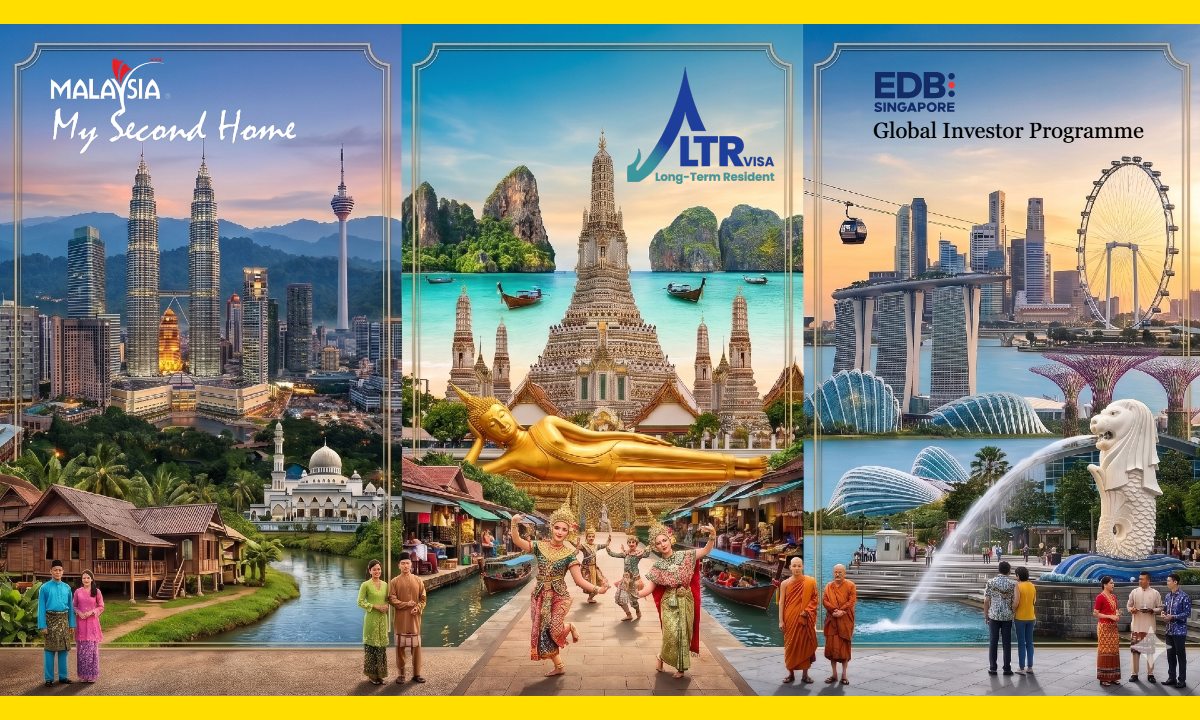

A side-by-side breakdown of costs, family rights, and tax benefits — so you can stop guessing and start planning.
If you are based in Singapore or Taiwan and seriously considering a second residency in Southeast Asia, you have probably already heard the three names: MM2H, LTR, and GIP.
You may also have found that the internet is full of contradictory information, outdated figures, and articles that conveniently leave out the hard parts.
We are Hartamas International, and this is our attempt to give you a straight answer. We work with high-net-worth individuals and families navigating Malaysian residency — and we know this decision is not made lightly.
It involves real capital, your family’s future, and sometimes, the question of whether you ever want to come back.
This article breaks down all three programmes side by side: what they cost, what you get, who can come with you, and — critically — what each one does not tell you upfront.
Key Takeaways at a Glance
- Malaysia MM2H is the most family-friendly — it allows three generations (parents, in-laws, and adult children up to 34) under a single residency.
- Singapore GIP is the only programme offering a direct path to PR and eventual citizenship, but it demands S$10M–S$25M in capital commitment.
- Thailand LTR offers the cleanest tax shelter for mobile professionals: LTR holders are fully exempt from Thai tax on foreign-sourced income under Royal Decree No. 743.
- MM2H now requires a mandatory property purchase within 12 months of endorsement — this is a capital lock-in, not just an incentive.
- Cost of premium living in KL (~$2,330/month) is roughly a third of Singapore (~$8,000+/month) for comparable quality.
- No programme is universally better. The right choice depends on your capital, your family structure, your tax profile, and your long-term intentions.
Table of Contents
- The Programmes at a Glance: A Full Comparison.
- Malaysia MM2H: The Family-First, Property-Backed Residency.
- Thailand LTR Visa: The Tax-Smart Professional’s Programme.
- Singapore GIP: Permanent Residency for the World’s Most Committed Capital.
- Property Ownership: Where Your Money Actually Goes.
- The Real Cost of Living: KL vs. Bangkok vs. Singapore.
- So Which Programme Wins?
- Ready to Make the Move?
The Programmes at a Glance: A Full Comparison
Before we go into the details, here is the complete side-by-side picture.Think of this as the table you will want to come back to as you read.
| Malaysia MM2H | Thailand LTR | Singapore GIP | |
|---|---|---|---|
| Programme Type | Residency Visa (Renewable) | Residency Visa (Renewable) | Permanent Residency (PR) |
| Min. Entry Cost (USD) | Silver: $150k FD + RM600k property | Wealthy: $500k Thai investment | S$10M–S$25M investment |
| Visa Duration | 5–20 years (by tier) | 10 years, renewable | Immediate PR (5-yr REP) |
| Work Rights | Platinum: Full; Silver/Gold: Restricted | Digital work permit included | Full work rights as PR |
| Path to Citizenship | None (PR possible separately) | None | Possible after 2 yrs PR (discretionary) |
| Family Inclusion | Spouse, children up to 34, parents & in-laws | Spouse + up to 4 children under 20 | Spouse + children under 21 only |
| Property Ownership | Freehold landed & apartments (no ABSD) | Condominiums only (49% foreign quota) | 60% ABSD for foreigners |
| Foreign Income Tax | Territorial — generally exempt | LTR holders: fully exempt (Royal Decree 743) | Taxed if remitted to SG |
| Min. Stay Requirement | 90 days/yr (under 50); none if 50+ | None specified | Performance-based REP renewal |
| Cost of Living (Family, 2026) | ~$2,330/month (premium lifestyle) | ~$2,760/month (premium lifestyle) | ~$8,000+/month (premium lifestyle) |
Source: Hartamas International, compiled from programme guidelines current as of April 2026. All figures in USD unless otherwise stated.
Malaysia MM2H: The Family-First, Property-Backed Residency
The 2026 version of MM2H is meaningfully different from what it was five years ago. It is more structured, more demanding on capital, and more explicit about what it expects in return. Here is what you are working with.
The Four-Tier Structure
MM2H now operates under four tiers — Platinum, Gold, Silver, and a Special Economic Zone (SEZ) tier anchored in Forest City, Johor:
| Tier | Visa Duration | Fixed Deposit (USD) | Min. Property (MYR) | Work Rights |
|---|---|---|---|---|
| Platinum | 20 Years | $1,000,000 | RM 2,000,000 | Full Permission |
| Gold | 15 Years | $500,000 | RM 1,000,000 | Restricted |
| Silver | 5 Years | $150,000 | RM 600,000 | Restricted |
| SEZ (Forest City) | 10 Years | $32k (50+) / $65k (21–49) | RM 500,000 | Restricted |
Source: Ministry of Tourism, Arts and Culture (MOTAC), Malaysia, 2026. Fixed deposit amounts in USD; property minimums in MYR.
A few things worth noting:
- The SEZ tier has significantly lower deposit thresholds, but restricts your property location to Forest City.
- Gold and Silver tiers allow restricted work rights — you will need a separate approval to take employment.
- Platinum holders get full work permission and the longest visa duration at 20 years.
The Property Mandate: What Nobody Tells You
This is the part that surprises most of our clients. Property ownership is no longer optional — it is a condition of residency. You must sign a Sale and Purchase Agreement (SPA) within 12 months of visa endorsement.
The upside:
- Malaysia allows freehold ownership, including landed property in eligible zones (subject to state-level rules)
- No ABSD
- Real Property Gains Tax drops to 10% from the sixth year onwards
The downside:
- The property cannot be sold for at least 10 years unless you upgrade to a higher-value unit
- 8% stamp duty on foreign property purchases from 1 January 2026
- Your capital is locked in — factor this into your liquidity planning
Stay Requirements and the Age Split
If you are under 50, you must spend at least 90 cumulative days per year in Malaysia to maintain your visa. If you are 50 or older, there is no minimum stay requirement.
This effectively creates two different programmes:
- A settlement visa for younger working families
- A lifestyle visa for retirees
Depending on your situation, this could be a feature or a frustration.
The MM2H Family Advantage
Here is where MM2H genuinely stands apart. The programme allows you to include:
- Your spouse
- Unmarried children up to 34 years old
- Your parents and parents-in-law
No other residency programme in the region covers three generations like this. If you are thinking about relocating as a family — including elderly parents — MM2H is the only option designed to accommodate that.
Thailand LTR Visa: The Tax-Smart Professional's Programme
Thailand’s Long-Term Resident visa is built for a different type of HNWI: the globally mobile professional who earns most of their income offshore and wants clean, legally protected fiscal clarity. In 2026, the LTR remains one of the most compelling options in Asia for exactly this profile.
The Four LTR Tracks
| LTR Category | Annual Income Req. | Asset / Investment Req. | Health Insurance Req. |
|---|---|---|---|
| Wealthy Global Citizen | USD 80,000 avg (2 yrs) | USD 1M assets + USD 500k Thai investment | USD 50,000 coverage |
| Wealthy Pensioner | USD 80,000 (at application) | USD 40k income + USD 250k Thai investment | USD 50,000 coverage |
| Work-from-Thailand | USD 80,000 avg (2 yrs) | Employer revenue >USD 50M (3 yrs) | USD 50,000 coverage |
| Highly Skilled Professional | USD 80,000 avg (2 yrs) | Targeted industry role | USD 50,000 coverage |
Source: Thailand Board of Investment (BOI), 2026. Income and asset thresholds in USD.
A few clarifications on eligibility:
- Wealthy Global Citizen track: The income floor was removed for those who meet the USD 1M asset + USD 500k investment threshold. Wealth, not cash flow, is what qualifies you.
- Work-from-Thailand track: For remote workers at large multinationals — your employer needs to have generated over USD 50M in combined revenue across the past three years.
- Highly Skilled track: Targets specific sectors — biotechnology, digital services, advanced materials. This is not a general talent visa.
The Tax Exemption That Makes LTR Exceptional
Here is the single most important thing to understand about the Thailand LTR visa in 2026: Thailand changed its tax rules in 2024 – anyone who stays 180+ days in a tax year and remits foreign income to a Thai bank account is now technically subject to Thai personal income tax, at progressive rates up to 35%.
LTR visa holders are explicitly carved out under Royal Decree No. 743 (except Highly Skilled Track) :
- They are the only category with a statutory blanket exemption on all foreign-sourced income
- This is not a grey area or a pending policy — it is codified law
- For HNWIs managing global portfolios, dividends, or multi-jurisdiction property income, this matters enormously
The LTR is essentially a legalised tax shelter: as long as you hold it, your offshore wealth is yours to keep.
What LTR Does Not Offer
- No path to citizenship
- No route to include parents or in-laws as dependants
- Property ownership is limited to condominiums, subject to the 49% foreign ownership quota per building
- Property yields in Thailand (5–8%) can be suppressed by tax on rental income and high exit costs
Thailand is a strong choice for the right investor profile. But if your priority is multigenerational family inclusion or freehold property ownership, it may not be your first call.
Singapore GIP: Permanent Residency for the World's Most Committed Capital
Singapore’s Global Investor Programme occupies a different category from the other two.
This is not a long-stay visa. It is permanent residency from day one — for those who can meet one of the highest capital thresholds in the world.
The Three Investment Pathways
- Option A (Business Investment): Minimum S$10 million into a new business or expansion of an existing Singapore operation. Active management required — hiring targets and spending milestones must be met by year five.
- Option B (Fund Investment): S$25 million into a GIP-approved fund that reinvests into Singapore-based companies. Better for investors who want exposure without operational responsibility.
- Option C (Family Office): Establishes a Singapore Single Family Office (SFO). Net investible assets must be at least S$200 million, of which S$50 million is deployed into Singapore-approved assets.
These are not small numbers. Unlike MM2H or the LTR, the GIP is performance-based — your right to remain depends on whether you are meeting the investment and employment benchmarks set at entry.
The PR Status and the Path to Citizenship
GIP grants immediate PR status upon investment verification — no waiting period, no provisional visa.
PR status is subject to a five-year Re-Entry Permit (REP) renewal. To renew under Option A:
- Your business must employ at least 30 staff (at least 50% Singaporean), OR
- You must have physically resided in Singapore for more than half the five-year period
Singapore is the only programme among the three with a realistic path to citizenship — possible after two years of PR, at the government’s discretion.
For Taiwanese HNWIs, this creates a specific complication:
- Singapore requires renunciation of your original nationality
- Potential loss of National Health Insurance (NHI)
- Complications with accessing Labor Pension funds before retirement age
The National Service Question
This is the detail that changes the conversation for families with sons. Male PRs and their second-generation male children are subject to National Service — a mandatory two-year military commitment.
For families planning to raise children in Singapore long-term, this is a real non-financial cost that must be weighed carefully before committing.
What GIP Does Not Offer
- No coverage for parents — they can only obtain a 5-year Long-Term Visit Pass, with no medical or education subsidies
- Residential property comes with a 60% Additional Buyer’s Stamp Duty (ABSD) for foreigners, while PRs face 5% ABSD (first property) and 30% (second property)
- Premium lifestyle costs in Singapore run at $8,000+ per month for a family, three to four times the equivalent in KL
Property Ownership: Where Your Money Actually Goes
For HNWIs, residency and real estate are rarely separate decisions. Here is how each jurisdiction treats your property rights:
- Malaysia (MM2H): Foreigners can buy freehold landed property in their own name, depending on the state mandate. No ABSD. RPGT drops to 10% from the sixth year onward. The 10-year minimum holding period is the main constraint.
- Thailand (LTR): Condominiums only, subject to 49% foreign ownership limits per building. Property yields of 5–8% can be eroded by rental income tax and high exit costs. Best suited for lifestyle use rather than serious capital deployment.
- Singapore (GIP): Residential property is a wealth preservation play, not a yield play. Most GIP investors focus on the business or fund commitments — property is secondary.
The Real Cost of Living: KL vs. Bangkok vs. Singapore
Numbers tell this story better than words.
| Metric (2026) | Kuala Lumpur | Bangkok | Singapore |
|---|---|---|---|
| Prime 2-Bed Rent (Monthly) | $850–$1,300 | $1,050–$1,600 | $5,000–$8,000+ |
| Top Int'l School Fees (Annual) | $13.8k–$30k | $15.9k–$31.3k | $21k–$38.7k |
| Specialist Medical Consult | $40–$70 | $50–$80 | $150–$250+ |
| Utilities & High-Speed Internet | $90–$130/month | $110–$150/month | $300–$500/month |
| Premium Lifestyle (Family of 3) | ~$2,330/month | ~$2,760/month | ~$8,000+/month |
Source: Asia Lifestyle Magazine 2026 Cost of Living Comparison; Visual Capitalist 2026 Global Cost of Living Index; Statista Rankings 2026.
The takeaway: Kuala Lumpur offers a comparable quality of life to Singapore — international schools, world-class hospitals, luxury serviced apartments — at roughly a quarter of the cost.
For families thinking long-term, this compounding cost difference is not trivial.
So Which Programme Wins?
Honestly? It depends on your situation. Here is how we usually frame it for our clients:
Choose MM2H (Silver or Gold) if:
- You are planning a full family relocation
- Your parents are coming with you
- You want freehold property as part of your wealth strategy
- You value the cost of living in KL
This is the programme for the family-oriented patriarch or matriarch building a multigenerational base.
Choose Thailand LTR if:
- You earn predominantly offshore
- You need a legally airtight tax exemption on foreign income
- You do not need to include parents as dependants
This is the programme for the globally mobile professional who wants fiscal clarity without a property obligation.
Choose Singapore GIP if:
- Capital is not your primary constraint
- You want a Tier-1 passport in the long run
- You are building a serious business or family office structure in Asia
This is the programme for the institutional billionaire or family office principal who wants the most prestigious address in the region.
The regional market has matured. Malaysia has the lifestyle and the families. Thailand has the tax structure and the talent. Singapore has the prestige and the passports. None of them is wrong — the question is which one is right for you, right now.
Ready to Make the Move?
At Hartamas International, we specialise in guiding high-net-worth individuals through Malaysia’s MM2H programme — from initial eligibility checks to property acquisition and long-term settlement planning. We have helped clients from Singapore and Taiwan navigate every tier of the programme, and we know the questions you have not thought to ask yet.
Visas get renewed. Markets shift. But the decision you make about where to put down roots — that one stays with you. We would rather you make it with full information than with a brochure.
So here is our question for you: Which generation are you planning for?
Contact us today for a complimentary MM2H consultation. Let us find the right tier, prepare your documents, and get you moving.
Disclaimer: This article is intended for general informational purposes only and does not constitute legal, tax, or financial advice. Programme requirements, fees, and eligibility criteria are subject to change. Readers are advised to consult qualified legal and tax professionals before making any residency or investment decisions. All figures cited are based on data available as of April 2026.